
Principle
One way to produced labelled extracellular vesicles (EVs) is to bioengineer the producing cells by using DNA. in-EV DNA can be used to transfect cells that will naturally produce labelled EVs in the culture medium. Transient transfections can be performed for fast screening and small scale productions. Transfections to establish stable cell lines are also possible thanks to zeocin resistance.
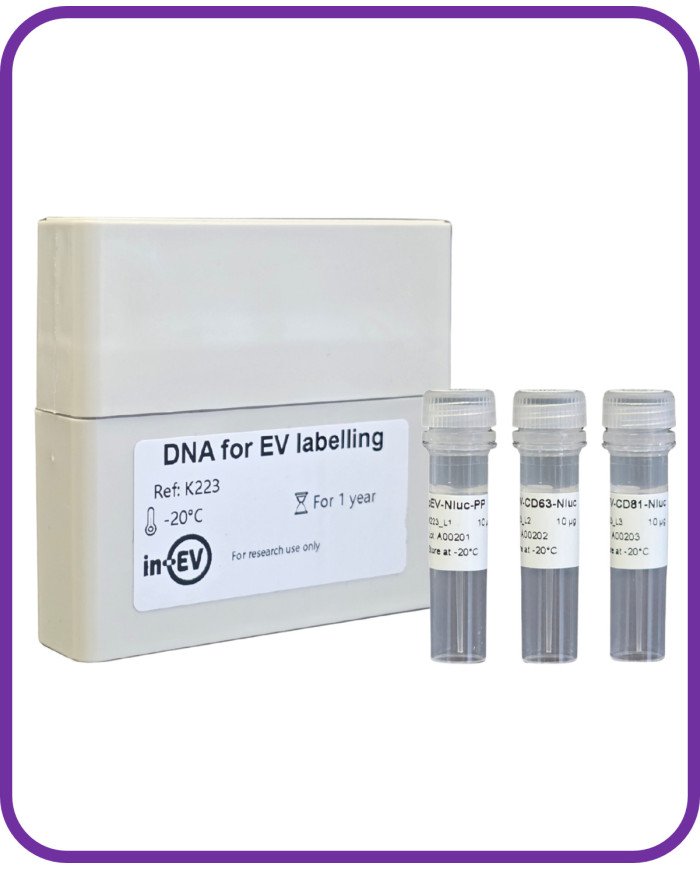
3 DNA are available for 3 distinct targeting of NanoLuc® Luciferase (luminescent protein) into EVs:
- NanoLuc-PP: NanoLuc flanked by 2 peptides for internal membrane anchoring and sorting into EVs
- CD63-NanoLuc: NanoLuc fused with CD63 for EV targeting
- CD81-NanoLuc: NanoLuc fused with CD81 for EV targeting
NanoLuc® Luciferase : luminescent protein | λem = 480 nm
Specifications
| DNA quantity | 10 µg |
| DNA concentration | 0,5 mg/mL |
| Buffer | TNE 1X, sterile |
| Storage | Store sterile at -20°C, up to 1 year |
Strengths of DNA for EV-Labelling with NanoLuc® Luciferase protein
- Specific labelling, no leakage
- Allow to track EVs in vivo
- Strong promoter
- Ampicillin resistance
- Zeocin resistance
Important information
You are hereby granted a limited, non-exclusive, non-transferable license to use the optimized sequences generated through in-EV for non-commercial purposes, including but not limited to research and development and product development, subject to the restrictions set forth in our Terms of Use (Article 4, Scope of Use and Restrictions).
NanoLuc® is a registered trademark of Promega Corporation. NanoLuc® Technology is licensed from Promega Corporation.