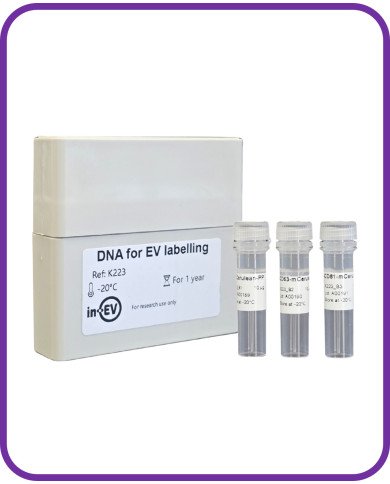
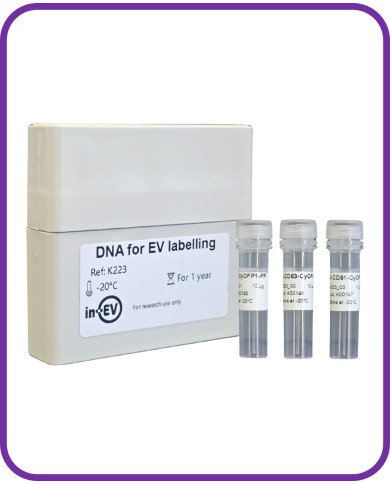
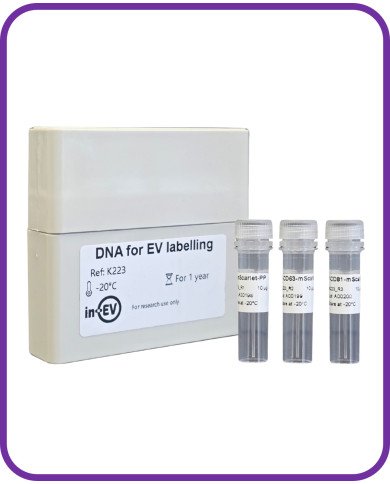
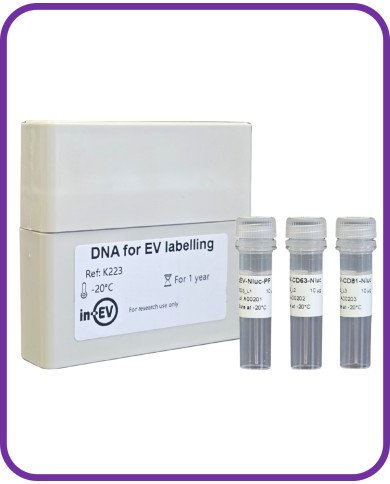
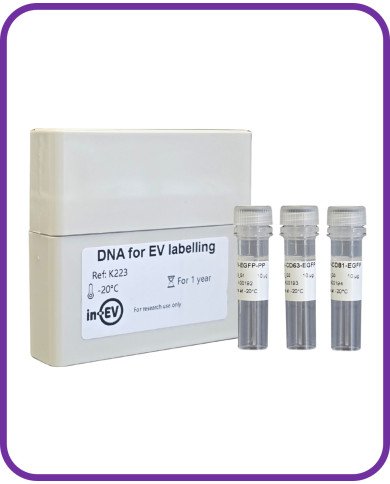
Reference K223
DNA allowing to transfect cells that will produce EVs, loaded with fluorescent or luminescent proteins.
One way to produce labelled extracellular vesicles (EVs) is to bioengineer the producing cells by using DNA. in-EV DNA can be used to transfect cells that will naturally produce labelled EVs in the culture medium. Transient transfections can be performed for fast screening and small scale productions. Transfections to establish stable cell lines are also possible thanks to zeocin resistance.
For each color, 3 DNA are available for 3 distinct targeting of the label protein into the lumen of EVs:
Label-PP
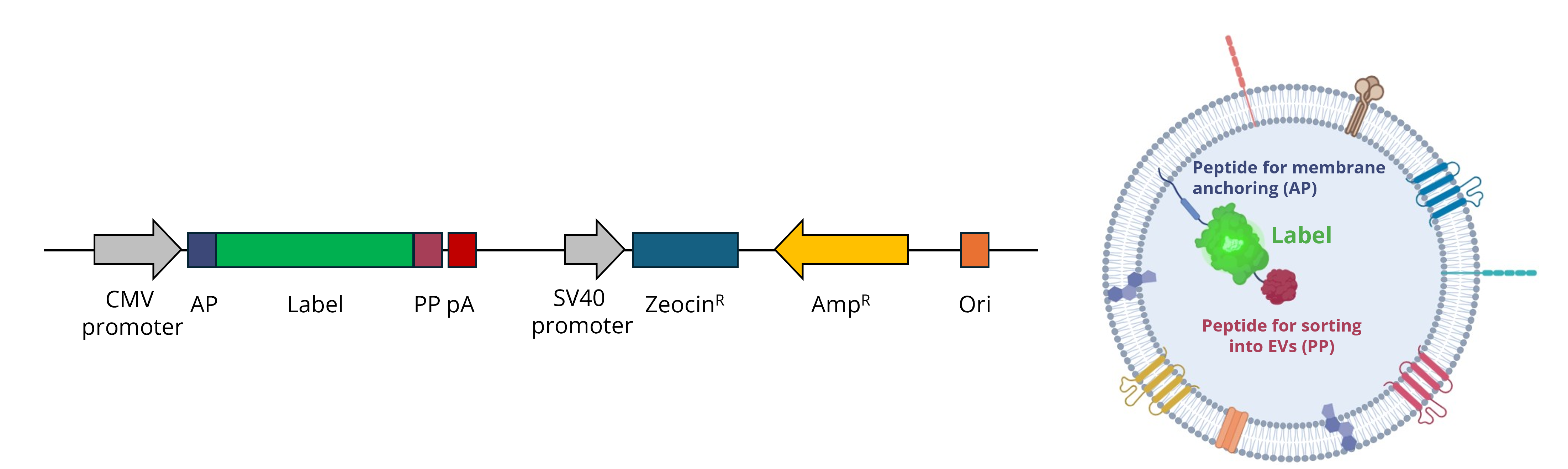
These first DNA were developed using Ciloa technology, which relies on active sorting of any kind of protein to the EVs produced by eukaryotic cells. A synthetic DNA optimised for coding mCerulean, EGFP, CyOFP1, mScarlet or NanoLuc® Luciferase, is fused in N-terminus to an Anchoring peptide (AP, allows internal membrane anchoring) and in C-terminus to a proprietary Pilot peptide (PP, for sorting into EVs). The resulting chimeric gene is cloned into an eucaryotic expression vector. This vector allows transcription in eukaryotic cells of a mRNA coding for the chimeric AP-Label-PP protein.
With Label-PP DNA, there is not overexpression of natural EV protein and therefore, minimal modification of EV surface and EV natural properties.
These DNA allow you to track your EVs in vivo and in cellulo, without altering their biology.
Schematic representation of the gene encoding Label-PP proteins and EVs loaded with Label-PP proteins.
CD63-Label
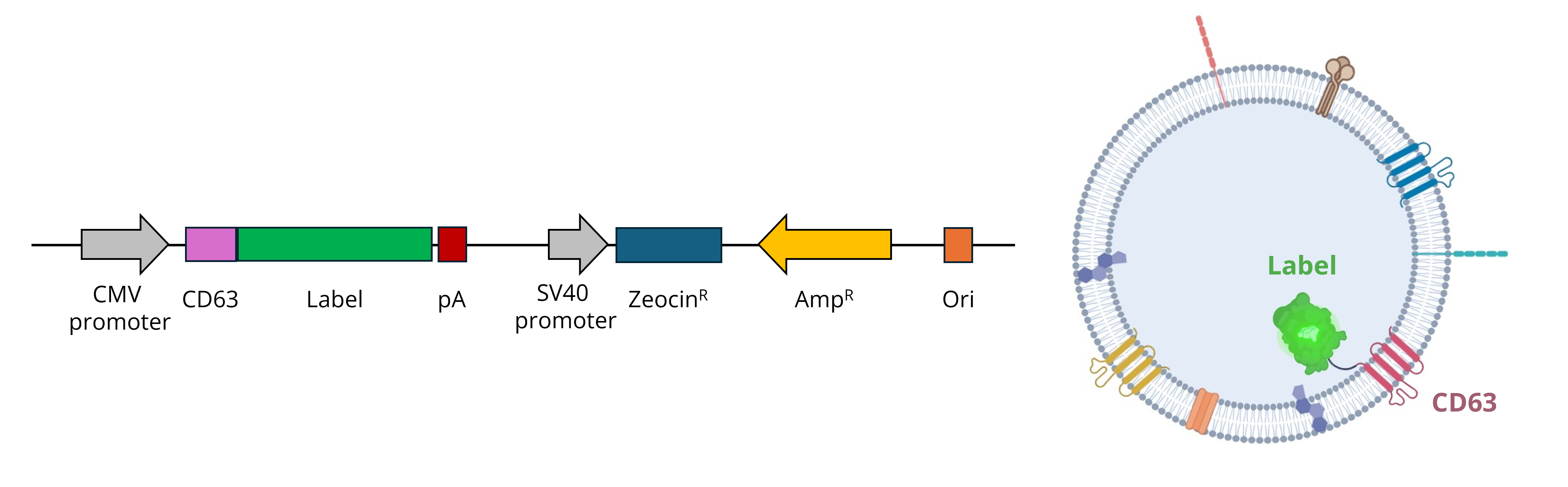
A synthetic DNA optimised for coding mCerulean , EGFP, CyOFP1, mScarlet or NanoLuc® Luciferase, is fused in N-terminus to CD63. The resulting chimeric gene is cloned into an eucaryotic expression vector. This vector allows transcription in eukaryotic cells of a mRNA coding for the chimeric CD63-Label protein
Schematic representation of the gene encoding CD63-Label proteins and EVs loaded with CD63-Label proteins.
CD81-Label
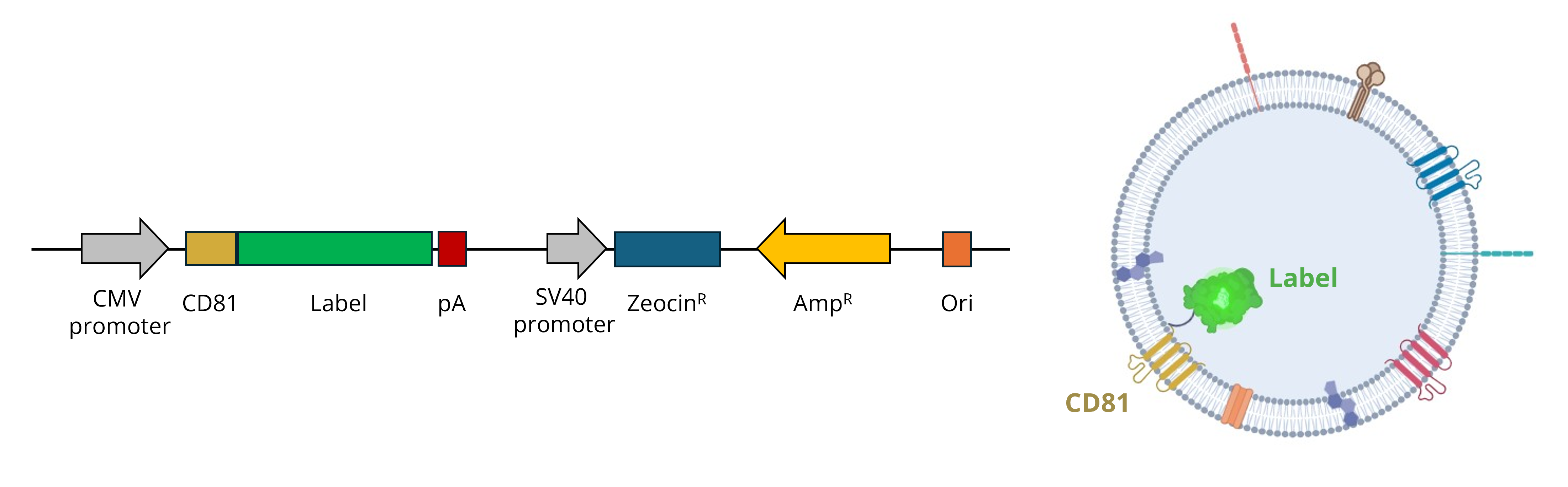
A synthetic DNA optimised for coding mCerulean , EGFP, CyOFP1, mScarlet or NanoLuc® Luciferase, is fused in N-terminus to CD81. The resulting chimeric gene is cloned into an eucaryotic expression vector. This vector allows transcription in eukaryotic cells of a mRNA coding for the chimeric CD81-Label protein.
Schematic representation of the gene encoding CD81-Label proteins and EVs loaded with CD81-Label proteins.
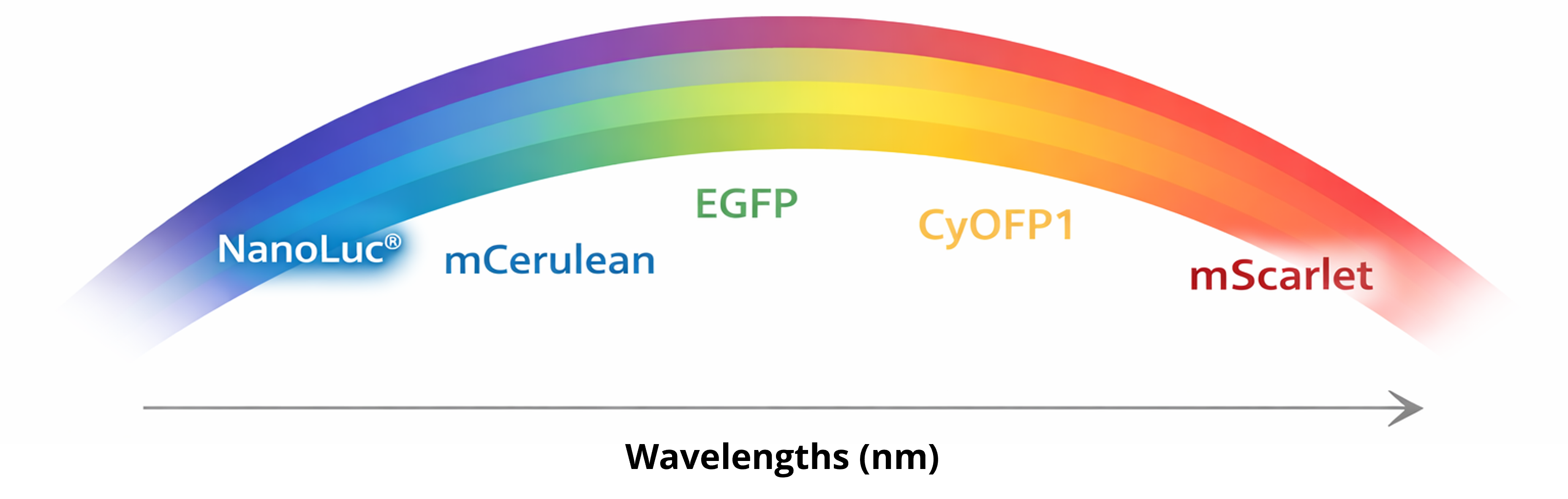
5 colors available:
• Blue ⟶ mCerulean | λexc = 433 nm ; λem = 475 nm
• Green ⟶ EGFP (Enhanced Green Fluorescent Protein) | λexc = 488 nm ; λem = 507 nm
• Orange ⟶ CyOFP1 (Cyan-excitable Orange Fluorescent Protein) | λexc = 497 nm ; λem = 589 nm
• Red ⟶ mScarlet | λexc = 569 nm ; λem = 594 nm
• Luminescent ⟶ NanoLuc® Luciferase | λem = 480 nm
DNA for EV Labelling are dedicated for the transfection of cells that will produce fluorescent or luminescent EVs. For cell transfection, follow the protocol adapted to the cells you will transfect.
o Specific labelling, no leakage
o 3 ways for EV targeting
o 5 colors available
o Strong promoter
o Ampicillin resistance
o Zeocin resistance
15 DNA available:
| mCerulean | EGFP | CyOFP1 | mScarlet | NanoLuc® | |
| Proprietary technology |
pEV-mCerulean-PP |
pEV-EGFP-PP |
pEV-CyOFP1-PP |
pEV-mScarlet-PP |
pEV-NanoLuc-PP |
| Fusion with CD63 |
pEV-CD63-mCerulean |
pEV-CD63-EGFP |
pEV-CD63-CyOFP1 |
pEV-CD63-mScarlet |
pEV-CD63-NanoLuc |
| Fusion with CD81 |
pEV-CD81-mCerulean |
pEV-CD81-EGFP |
pEV-CD81-CyOFP1 |
pEV-CD81-mScarlet |
pEV-CD81-NanoLuc |
Data sheets can be downloaded by clicking on the reference.
Important information
You are hereby granted a limited, non-exclusive, non-transferable license to use the optimized sequences generated through in-EV for non-commercial purposes, including but not limited to research and development and product development, subject to the restrictions set forth in our Terms of Use (Article 4, Scope of Use and Restrictions).
Start typing to see products you are looking for.
This website use cookies to ensure you get the best experience on our website.privacy policy